Hallowell
Mariners' Museum, Uncurated Search Results
Type: Schooner Barge
Year: 1919
Builder: Crosby Navigation Co.
Location: Richmond
These records are found in the online catalog of The Mariners’ Museum and Park in Newport News, Virginia. Uncurated search results are presented to give researchers and interested readers an idea of whether the museum’s archives contain information about this vessel and whether it may be worthwhile to visit the museum’s catalog search page for further investigation. Uncurated results may be inaccurate or incomplete.
Search mode: Exact Name. Search phrase(s): "Hallowell". Results returned: 13. Results displayed in this table: 13.
Use these buttons to send uncurated search results to your own app or text document for further research. First, check the box for any row, or click "Select All" then uncheck any rows. Then click "Show Selections". You can then copy your selections from the text box and past them into your app.
| Fetch? | Row ID | Media | Date | Vessel | Place | Related Places | Inscription/Marks | Subject | Notes | Archive Number |
|---|---|---|---|---|---|---|---|---|---|---|
| 1 | No image URL. | 1918 | Caption: "Hallowell, ME. 1918" | MS0003/-004.966 | ||||||
| 2 | No image URL. | Ordered 6/20 BAMM | LB84529 | |||||||
| 3 | No image URL. | Hallowell (Me.)–Biography; Augusta (Me.)–Biography; Kennebec River Valley (Me.)–Social life and customs. | Midwives–Maine–Hallowell–Biography; Midwives–Maine–Augusta–Biography | A midwife's tale : __the life of Martha Ballard, based on her diary, 1785-1812 __Laurel Thatcher Ulrich | LB101196 | |||||
| 4 | No image URL. | Sketches of the history of the town of Camden, Maine : __including incidental references to the neighboring places and adjacent waters __by John L. Locke | LB10653 | |||||||
| 5 | No image URL. | Serieuse (Frigate : 1779).; Orient (Ship : 1795).; Le Guillaume Tell (Ship : 1795).; Le Genereux (Ship : 1785).; Guerrier (Ship-of-the-line : 1753).; Conquerant (Ship-of-the-line : 1765).; Spartiate (Ship-of-the-line : 1797).; Aquilon (Ship-of-the-line : 1789).; Peuple Soverain (Ship-of-the-line : 1792).; Mutine (Brig : 1797).; Audacious (Frigate : 1785).; Culloden (Ship-of-the-line : 1783).; Vanguard (Ship-of-the-line : 1787).; Orion (Ship-of-the-line : 1787).; Theseus (Ship-of-the-line : 1786).; Alexander (Ship-of-the-line : 1778).; Goliath (Ship-of-the-line : 1781).; Zealous (Ship-of-the-line : 1785).; Franklin (Ship : 1797). | Of men and ships : __Nelson's band of brothers at the Nile | LB103385 | ||||||
| 6 | 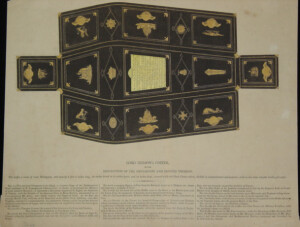 | NOTES: In a public exercise as symbolic as Nelson's state funeral, details are everything. A good deal of popular attention was fixed on matters like the construction and ornamentation of the funeral carriage and coffin. This engraving provides, in excrutiating detail, a description of the hero's "stout Mahogany" coffin, covered in "rich black Genoa velvet" and decorated "with no less than 10,000 double gilt nails. "Yet for all the attention given to this official coffin, Nelson's biographers are virtually unanimous in their claim that he was in fact placed in a coffin made of wood from the mainmast of the French flagship 'L'Orient' destroyed at the Battle of the Nile in 1798. LABLE COPY: Lord Nelson's Coffin... Engraving, 1806 Gift of Mr. James E. Jewell 85.46.45 Nelson's body was placed in a coffin made from the main mast of the French L'Orient before being placed in the official casket for interment. LABEL COPY: Lord Nelson's Coffin Etching Gift of Mr. James E. Jewell 1985.46.45 Nelson's mahogany coffin bore gold designs symbolizing his many victories over France and Spain. It is believed that his body was first placed in a coffin made from the mainmast of the French first-rate L'Orient sunk at the Nile. GALLERY GUIDE: "The Immortal Memory" Admiral Horatio Nelson, 1758-1805 Exhibit: 9/27/86-3/28/88 (Guide's dates: 9/27/86-3/22-87) In a public exercise as symbolic as Nelson's state funeral, details are everything. A good deal of popular attention was fixed on matters like the construction and ornamentation of the funeral carriage and coffin. This engraving provides, in excruciating detail, a description of the hero's "stout Mahogany" coffin, covered in "rich black Genoa velvet" and decorated "with no less than 10000 double gilt nails. "Yet for all the attention given to this official coffin, Nelson's biographers are virtually unanimous in their claim that he was in fact placed in a coffin made of wood from the mainmast of the French flagship L'ORIENT destroyed at the Battle of the Nile in 1798. Captain Ben Hallowell, one of Nelson's "Band of Brothers" at the Nile battle, had the piece constructed as a joke. Nelson appears to have carried it along with him for the rest of his career. As not even the French could rig a major warship with masts of "stout Mahogany." Baltic pine being a more likely choice, it is likely that the L'ORIENT coffin was placed inside the impressive official casket for interment. Dim: 12" x 15-1/4" (30 x 39 cm) Gift of James E. Jewell (Nelson 6/26/98) | CL22158 | |||||||
| 7 | 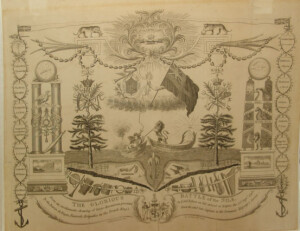 | SHORT DESCRIPTION: Black and white etching and engraving on paper, an "emblematic drawing" celebrating the Battle of the Nile. Engraved by Simpkins Clements Published by Bunney and Gold, April 1, 1800. Modern molded giltwood frame, velvet mat, giltwood liner. Print has been conserved and a rice paper backing has been added. | CL29358 | |||||||
| 8 | No image URL. | Great Britain. Royal Navy–Biography. | Nelson and his captains : __sketches of famous seamen __by W.H. Fitchett ... with portraits and a facsimile letter | LB6985 | ||||||
| 9 | No image URL. | Great Britain–History, Naval–19th century. | Reminiscences of a naval officer, during the late war : __with sketches and anecdotes of distinguished commanders __by Captain A. Crawford ... Embellished with portraits of Admirals Sir Edward Owen and Sir Benjamin Hallowell Carew | LB8108 | ||||||
| 10 | No image URL. | Bangor (Side wheel steamer : 1834); Marmora (Screw steamer : 1844). | Diplomatic and consular service, American–Salaries, etc.; Diplomatic and consular service, American–Selection and appointment. | This is a collection of three photostat copies of letters, written between 1860 and 1861, by Rufus King Page and his son William Page, concerning the younger Page's attempts to gain a preferable diplomatic appointment. These letters are of interest in that they mention the steamers Bangor and Marmora. This Bangor may be the famous steamer of that name, the first iron-hulled vessel to cross the Atlantic, but William Page claims he took that voyage on Bangor in 1842. The pioneering steamer was first put in service in 1845. He likely boarded a vessel by that name built in 1834. | MS0323 | |||||
| 11 | 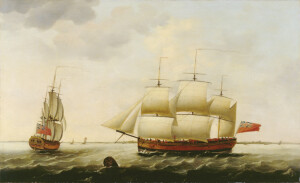 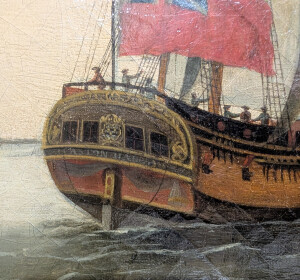 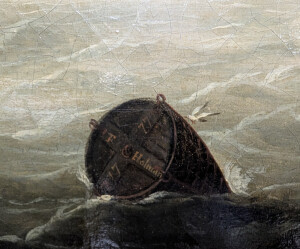 | SHORT DESCRIPTION: Oil painting by Francis Holman showing the ship Aston Hall from two perspectives. The main portrait shows the broadside view. The secondary image shows a stern view after the ship has steered onto a new course. The background shows many small sailing vessels and the coastline. NOTES: As a painting of a Chesapeake Bay built vessel, this piece is an extreme rarity; as a early ship portrait, this is equally a rarity. Currently, there are no extant portraits of vessels documented to have been built in the Chesapeake before the Revolution. As this area was a major source of the smaller merchant vessels in use by the British, it is evident that any documentation of this trade would be of great importance. VESSEL HISTORY: [J. Willoz-Egnor, 5/15/2024] The 'Aston Hall' was a 300-ton ship built in Baltimore, Maryland in 1773 for T. Curtis. Her captain was John Parker and she journeyed between Halifax and London until the Revolution. The ship most likely carried tobacco to England and returned with fabrics, dishes and machinery. --The book 'Shipping in the port of Annapolis 1748-1775' by Vaughan W. Brown (1965) states: Aston Hall was a ship of 200 tons with a square stern. Built in Maryland 1773. Documented London, April 30, 1774, John Parker captain, John Parker and others owners. --Proceedings of the Committee for the County of Baltimore, volume 4:1719: At a meeting of the Committee, July 3, 1775: Present, Mr. Samuel Purviance, Chairman, and thirty Members; William Lux, Secretary. Captain John Parker, of the Ship Aston Hall, from London; Captain Nicholas Fortune, of the Snow Catharine, from Youghall; and Captain Richard Curtis, of the Brig Curtis, from Waterford, severally appeared, reported their vessels, and took the Oath. --Naval Documents of the American Revolution (Vol. 1): Voyage July 4, 1775, ship Aston Hall, John Parker, Master, 200 tons, 14 men, from London to Baltimore, carrying 98 convicts. --The Newcastle Weekly Courant, April 13, 1776, page 4, reports: Extract of a letter from Cork, March 29, yesterday morning the following transports arrived here...The Aston Hall, captained by Parker, from London. The ships are expected to sail in a few days for Boston, are to be convoyed by two men of war. --'The Flight of American Loyalists to the British Isles' by Wilbur H. Siebert (1911) states: The diaries kept by Samuel Curwen and Governor Hutchinson during their long exiles in the mother country contain frequent references to arrivals of these New England people from Halifax. On June 10, 1776, Curwen records the arrival of as many as six vessels laden with refugees from this harbor, and names a few of the passengers. Another entry by Curwen, under date of June 26, tells that two or three companies of Bostonians have lately come from Halifax; a few days later a newspaper reports that the "Unity," from Georgia and Halifax, landed several families at the port of London who had run away from the troubles in America; and from various sources we learn that the ship "Aston Hall", which sailed from Halifax in July with the commissioners of the customs and a large contingent of refugees, landed at Dover towards the middle of August. ['Biographical sketches of loyalists of the American Revolution, with an historical essay' indicates the following people were on this voyage: 1) Nathaniel Coffin, Last Receiver-General and Cashier of his Majesty's Customs of Boston with his family of three. 2) Benjamin Hallowell, Commissioner of Customs at Boston. 3) Henry Hulton, Commisioner of Customs at Boston.] --Naval Documents of the American Revolution (Vol. 6): Engaged by the British Ordnance Department for America, August 31, 1776: For what place: Ceded Islands; Tons burthen: 370; Number of sailors at 7 to 100 tons: 26; Extra sailors to make 5 per gun: 10; Number of recruits: 60; Number and nature of guns: two 9-pounders, ten 6-pounders. --Jackson's Oxford Journal, November 22, 1777, page 1 reports: Extract of a letter from Chesapeake Bay, dated September 14, 1777: On Thursday last the remainder of the fleet under convoy of his Majesty's Ship the Experiment of 50 guns, Sir James Wallace, Commander; the Bristol, of 50, J. Renier, Esq; Commander; the Buffaloe (an old 70), Henry Bramedge, Esq; Commander; and Zebra, Hen. J. Talmash, Esq; Commander; with the Lord Howe, and Aston Hall Ordnance Transports. There are about 3000 Soldiers in the Fleet, and the following Passengers are also arrived, viz. Major-Gen. Robertson, Major-Gen. Wilson, Major-Gen. Patterson, the Marquis of Lindsay, Lord Cathcart, Count Gablouskie, Capt. Williamson of the Royal Artillery, and Mr. James Rivington, &c. --In 1778 she was commanded by John Austin and was used as a transport for the British government. The vessel spent two years as a transport vessel and in 1780 she made her first voyage to Jamaica. The 'Aston Hall' disappears from the register in 1782. --The Ipswich Journal, December 18, 1779, page 1, reports: The following ships from Lisbon arrived at Portsmouth yesterday...Aston Hall, Austin. --The document 'Letters of Marque Declarations Against America Index.pdf' index of ships and commanders (between November 8, 1780 and January 20, 1783) indicates that Aston Hall under John Austen (Folio Number 130, Reel 1 Index A, Volume 60) was given a letter of marque. --The Aston Hall was wrecked in Jamaica during the Great Hurricane of 1780. Documented in The Marine List, New Lloyd's List, January 5, 1781: The Aston Hall, Austin, belonging to London, was totally lost in the late Hurricane at Jamaica. The 'Great Hurricane of 1780' hit Jamaica on October 3. It is the deadliest Atlantic hurricane and tropical cyclone in the Western Hemisphere on record. An estimated 22,000 to 27,000 people died. | CL13120 | |||||||
| 12 | 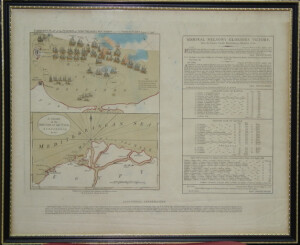 | SHORT DESCRIPTION: Broadside showing a map of the Battle of the Nile and reprinting dispatches from Horatio Nelson to Lord St. Vincent alerting him of the battle, numbers of casualties, captured vessels, and incidents that followed the battle. | CL23502 | |||||||
| 13 | 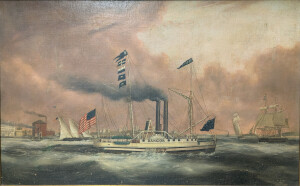 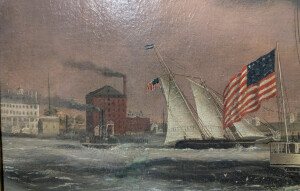 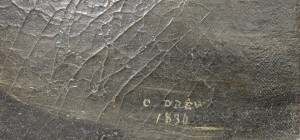 | SHORT DESCRIPTION: Oil paintng on canvas by Clement Drew showing a starboard broadside view of the side-wheel steam packet Bangor of the Boston & Bangor Steamboat Company off East Boston. The vessel is shown underway, leaving Boston harbor with sails furled. Smoke is pouring from its stacks. It flies a triangular naval jack at the bow, an American national flag at the stern, a triangular pennant, navy blue with the ship's name in white, on the foremast and a swallowtail flag, navy blue with a large white B, on the mainfast. Bangor is flying signal flags of the Elford Telegraphic system which was in use in Boston Harbor. The code reads 5244. In the background at the left, near Bangor's stern, is a US Revenue cutter under full sail. To its left is the East Boston waterfront. Prominent is the Boston Sugar Refinery, an eight-story red brick building built between Webster and Sumner Streets in 1834. In the water in front of it is the East Boston wharf and a steam ferry. To the left of the refinery is the Maverick House Hotel, an 80-room luxury hotel built by the East Boston Company to attract vacationers. In the background behind Bangor is open land with large white houses. To its right are several sailing vessels (a topsail schooner and a full rigged ship) and another steamboat. The sailing ship in the background at the right is also flying Elford signal flags (although one appears upside down): 62(?)54. The fessel is sailing under topsails only. The topgallant sails are brailed up and in the process of being furled by the crew. NOTES: This is the earliest known painting by artist Clement Drew. NOTES: [Excerpt from International Marine Engineering, Old American Coasting and Sound Steamers, Part II, by Francis Bradlee, May 1912, pg 201] In 1833 the Boston & Bangor Steamship [sic-Steamboat] Company started with a wooden side-wheel boat called the Bangor, built in New York by Brown & Bell. She was about 160 feet long, and had a "crosshead" engine with a cylinder 36 inches in diameter, 9 feet stroke. This vessel was sold to the Turkish Government in 1842, and sent across the Atlantic to Constantinople. Text from 'Report of Steam Navigation in the United States' by T.C. Purdy, page 9: In 1833 the Boston and Bangor Steamship [sic-Steamboat] Company was formed. They built the steamer Bangor in New York, and placed her on the route between Bangor and Boston. She was of 400 tons burden and rigged with fore and aft sails, with square engines without a walking-beam. She burned wood, consuming about 25 cords each trip. The capital of this company was held mostly in-Boston. The Bangor continued on this route until 1842, when she went to the Mediterranean. [Jeanne Willoz-Egnor, 4/29/2026] The history of the company that owned Bangor is very confused in published literature. Looking at newspaper reports it appears that the Boston & Bangor Steamboat Company was formed in 1833 or 1834. It owned two vessels, the steam packets Bangor and Independence. Periodically, the company is referred to as the Boston & Bangor Steamship Company or the Boston & Bangor Steam Navigation Company. In 1836, the company leased a pier with the Cumberland Steam Navigation Company, which owned the steam packet Portland, and the two companies operated from the wharf at the bottom of Hanover Street called the Eastern Steamboat Wharf. The Boston & Bangor Steamboat Company held stock holders meetings between 1835 and 1843. The Independence, Captain Howe, was sunk in October 1836 and the Bangor was sold to a Mediterranean concern in 1842. In December 1881 the Sanford Steamship Company petitioned to change the company name to the Boston & Bangor Steamship Company, which it did in 1882. In 1901 this company was consolidated into the Eastern Steamship Lines. VESSEL HISTORY: --The Daily News, March 19, 1834, page 3: The Bangor, of Boston. The steamboat Bangor, building at New York for the Boston and Bangor Steam Navigation Company, will be launched on Tuesday next, and is expected to be here by the first of May. She will surpass every steamer ever seen in Boston harbor. Her dimensions are 145 feet keel, 158 feet on deck, 25 feet beam and 10 feet depth of hold. She is constructed of the very best materials, is of extra strength, and most beautiful model. Her engine will be as good as can be made in the world, both in regard to safety and strength, and we may add beauty also. The cylinder is 44 inches in diameter, and has a nine foot stroke. Its power at least is estimated at 160 horse. The builders of the Bangor are Messrs. Brown & Bell, and her engine will be constructed under the direction of J. P. Allaire, Esq. the owner of the Charleston Packets David Brown and William Gibbons. She will have six large boats or tenders--sufficient for all her passengers and crew in case of necessity, --which are building by Mr. B.G. Guild, Fulton street. Her fixtures, furniture, upholstry, &c. will be purchased or made in Boston. Her berth will be at T. wharf. The Bangor will be a fast boat, accomplishing her 12 knots an hour with case, although the speed of boats is usually much exaggerated. The fastest boat in New York, with the exception of Burden's newly invented patent steamer, is the North America, and her speed through the water is only thirteen miles an hour. Boats have however, assisted by a strong current, gone through and with the water, twenty miles an hours. We shall look for the Bangor with much interest, as her arrival will form an era in the history of our intercourse with the East. --Boston Post, July 4, 1834, page 3: [advertisement] Steam Packet Bangor, Fourth July, The new and splendid steam packet Bangor, Capt. George Barker, will make the following excursions among the islands and round the Bay and Harbor--will leave the T wharf in the following order: at 9 o'clock, AM and return at 11 AM--will leave again at 3 o'clock PM and return at 5 PM. In the evening will leave at 6-1/2 o'clock and return at 8-1/2 o'clock. Tickets may be had at the office on the T. Fare for each excursion 50 cents. --Boston Post, July 8, 1834, page 2: Steam Packet Bangor, The Directors of the Boston and Bangor Steamboat Company, give notice, that the new and splendid steam packet Bangor, will leave T wharf on Friday morning at 7 o'clock, for Portland and Bangor, arrive at Portland at 5 o'clock PM. Leave Portland on Saturday at 7 o'clock AM, and arrive at Bangor at 6PM. Will leave Bangor on Tuesday morning at 7 o'clock and arrive at Portland at 6 o'clock PM. Will leave Portland on Wednesday morning at 7 o'clock, and arrive at Boston at 5 o'clock PM. Fair to Portland $3, to Bangor $6. For passage apply on board the Packet, or at Isaac W. Goodrich's 58 Washington Street. --Boston Post, July 12, 1834, page 2: The New Steam Packet Bangor, sailed yesterday at 7 o'clock, on her first trip for Portland and Bangor, with about 200 passengers. --Boston Post, August 11, 1834, page 3: The Boston and Bangor Steam Boat Company, have procured the new and splendid steam packet Bangor and placed her on the route between Boston and Bangor, under the commanded of Capt. Samuel H. Howes....The Packet Bangor was built expressly for sea navigation, by those experienced builders, Messrs. Bell & Brown, of New York. her engine is from the manufactory of J. P. Allaire, New York, and she is allowed by the most competent judges to be one of the best modeled and safest boats in the United States. In fitting her up no expenses have been spared to contribute both to the comfort and safety of the passengers. In addition to two powerful forcing pumps with suction hose, to protect her against any accident by fire, she is provided with five large boats, a large number of India rubber and cork mattrasses, one of which will sustain four men on the water. Will touch at Owlshead, Belfast, Bucksport and Frankport. For passage apply on board the packet at T wharf. Thomas S. Winslow, agent. --Eastern Argus, September 3, 1834, page 3: This is to certify that Capt. Samuel Orr has been engaged by me as pilot on board Steam Packet Bangor, and as such has given entire satisfaction, and I cheerfully recommend him as a suitable make for the situation. He has been honorably discharged this day. George Barker. Steam boat Bangor, July 26, 1834. --Many advertisements in 1834 show the Bangor maintained a busy schedule. --Bangor Daily Whig and Courier, September 17, 1834, page 2: carries an article discussing the removal of George Barker as captain of the Bangor. --Boston Post, November 4, 1834, page 3: report that the Bangor would discontinue her trips to Bangor of the winter season on November 8th, but will continue the route to Portland. On December 9th the Boston Post reported the steamers trips for the present season had been discontinued. --Portland Press Herald, April 14, 1835, page 2: The steam packet Bangor (says the Boston Transcript of Monday evening) left Lewis's wharf on Saturday afternoon for Portland, with nearly two hundred passengers, mostly active business traders. --Portland Press Herald, May 11, 1835, page 3: reports vessel is 400 tons burthen and is rigged with fore and aft sails in case of accident to the engine. Many improvements were made over winter. She was put on the Salem railway and coppered. Her cabins were lighted, and several staterooms were overhauled. --Portland Press Herald, September 3, 1835, page 3: Boston and Bangor Steam Navigation Company, New arrangements for the steamers Bangor and Independence...The above arrangement has been made in consequence of a satisfactory understanding with the Cumberland Steam Navigation Company. --Bangor Daily Whig and Courier, July 20, 1836, page 2: reports on an excursion to Castine, Maine on July 25th. --Advertisements show the vessel maintained an active service in 1836 and 1837. --Bangor Daily Whig and Courier, August 17, 1836, page 4: Advertisement for Eastern Steamboat Mail Line for Portland, Bath, Hallowell, Bangor, Eastport and St. John, NB. The ships listed included Portland (450 tons), Independence (500 tons), McDonough (300 tons), Bangor (400 tons), and Royal Tar (400 tons). --New York Daily Herald, November 30, 1837, page 3: steam packet Bangor, Howes, Boston, 2 days, with US troops. --Advertisements show the Bangor maintained an active schedule in 1838, 1839, 1840 and 1841. --Bangor Daily Whig and Courier, January 28, 1842, page 2: An advertisement by Captain Samuel H. Howes indicates "late of the steamer Bangor." --Boston Post, April 12, 1842, page 3: steamer Bangor, Captain J. B. Coyle, will leave Portland for Bangor... --Many advertisements show the steamer Bangor was actively sailing in 1842 under a new captain (Coyle). --Missouri Patriot, May 1, 1842, page 1: in an article titled 'Yankee Steamers in Foreign Waters' is a discussion of Mr. William R. Page of Hollowell, Maine who had dispatches from Mr. Everett, our minister at London, that Mr. Page was going to build steam vessels at Bath for use on the Mediterranean and the Black Sea. --Bangor Weekly Courier, August 9, 1842, page 3: The Steamer Bangor is advertised to make a trip to the Western Islands and the Mediterranean. --Alexandria Gazette, August 18, 1842, page 2: The steamer Bangor cleared on Saturday for the Mediterranean from Boston; her troubles have begun before she starts; as she was advertised to leave for certain a week since. --Bangor Daily Whig and Courier, December 10, 1842, page 2: Passed the Dardanelles, October 28, steamer Bangor, Dunn, from Gibraltar for Constantinople. The Bangor touched at Tunis for coals, and afterwards at Malta, whence she sailed October 21. --The Caledonian Mercury, December 12, 1842, page 4: The American steamer Bangor had arrived at Constantinople, and was to be employed as a tug. --Vicksburg Daily Whig, December 16, 1842, page 2: report about the steamer Bangor having left a few months since for the distant ports of Malta and Constantinople. | CL11796 |
Created 2026 by Don Barker, CBMM volunteer, for the Chesapeake Shipbuilding Project. shipbuilding@sailingworkboats.es